
Super Giant Camera Collage
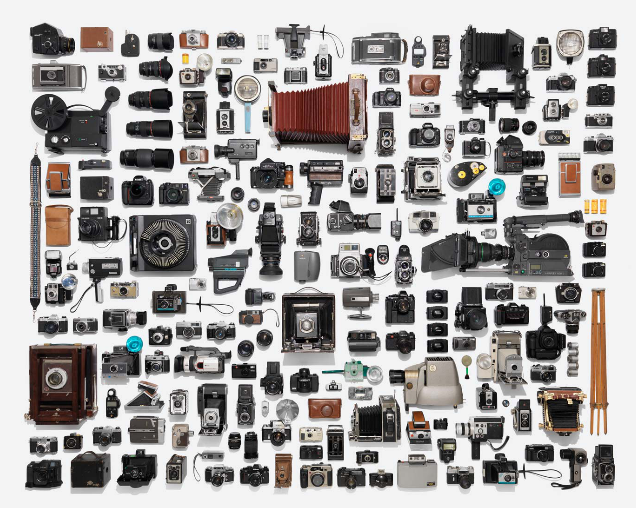
We were mesmerized by the meticulously arranged little camera parts in Jim Golden's still-life picture, which earlier this year earned kudos from several photography blogs.Golden moved from the advertising industry in New York City to live and work in Portland. He settled into a commercial and editorial studio off North Vancouver Avenue, and lately has been working on a "Collection" still-life photo series. And they're not small projects -- the one of cameras is 10 feet long!Golden graciously gave us a peek inside his brain and some insight to why humans like to collect stuff.E+E: So.. many.. camera things! How did you start collecting cameras and accessories from photographers?Jim Golden: I put the word out to 40 or so fellow photographers, photo enthusiasts and camera collectors and about 20 people came through with equipment. Some were friends of friends.
People were hyped on my other collection images, so once they saw that, they were convinced it'd be cool. I asked that everyone drop their equipment off the day before and we started returning the equipment a few days later...
People were very generous and trusting. I run a very professional, secure studio, we're often in charge of high profile samples from major corporations, so I think people felt their cameras would be safe. Some of the contributors stopped by during the shoot and hung out, swapped stories about the cameras and photo stuff. A lot of memories were passedaround. E+E: How much stuff did you eventually accumulate? Or did all of it make it into the photo shoot?Golden: We had about 250-275 pieces; around 190 made it in the photo. There were a lot of duplicates of some stuff (i.e., Polaroids) so we used some at different angles and the others we didn't use. A layout like this, some stuff will fit, some stuff won't.
E+E: When you started laying out the pieces, what was your plan for how you wanted it to look? Or was it free-form? How did you know where to arrange something?Golden: First off, I collaborate with a very talented stylist, Kristin Lane, and we formulate a rough plan of what we want the final image to be. Kristin is the hands on the floor and we hash it out.We start by spreading everything out on tables and picking the most interesting bigger items and place them on the floor until that feels balanced. Then we start working off them and/or building off the edges. Often we keep moving things around a bit after they are on the paper until we feel like we have a solid base to work off of and then go for it. The last 10-15 percent of the image can take hours, getting that last little bit right.The camera image took nearly 12 hours; it is the most objects we've ever photographed and the longest image to make by far. The final print is 10x8 feet and hangs at the Nike Photo Studio out on the Nike campus E+E: What inspired your collection series? I saw that you did other ones with rifles and scissors. What are your thoughts on how we collect things as people?Golden: My friend Rob has a HUGE (5000+) scissor collection and I'd wanted to shoot it for a while. He passed along 500 of his favorites and I was stumped on how to shoot them, my initial idea wasn't that interesting. A light bulb went off to shoot them as a group from above…A lot of my photography is fairly typological -- surveys of similar things -- cars on the street, houses on the Oregon coast, guns, etc. I think the collections are an extension of this, whether we build them or [whether] they are from one person.I think collecting is human nature in a way. Find stuff you like and hang on to it, enjoy it. We've been doing it for thousands of years. I think people collect stuff more than they realize -- gardeners for example!E+E: What do you, personally, collect, either intentionally or unintentionally For example, I seem to accumulate a million hair things, like bobby pins and such out of fear that I'll never be able to find a pin when I need it.Golden: Pictures of collections! Over the years a bunch of different stuff. Vintage plastic cameras, Polaroids, had a great sticker collection as a kid. I keep it a little more in check these days, I don't have a lot of space at home or the studio, so I've paired it down.Recently, I've started collecting friends' photographs and more photography ingeneral. Tech objects from the 70s and 80s have been making their way into my life as well lately.I had a dream the other night about collecting obscure French cars from the 50s and 60s in a barn; I'd just go in and pick one to drive and take off. One of my great loves is the car and car culture in general.Inadvertently, I have an never-ending collection of computer cables and mice.E+E: What are you working on now for your next collection? What's your next project?Golden: Some collections in the queue are vintage tin toys, skulls, vintage cell phones, bike stuff. I want to start making them move, some type of cinemagraph or GIF could be interesting. Kristin and I have also talked about making an interactive experience, where you roll over the objects and more info is available.
 The coast project has been ongoing for three years, I'd like to exhibit it and possibly make a book. I'm always amazed by the coast, the landscape, the weather, the architecture, the people. No end in sight, but I have a pretty good edit going.I have a project about churches in unconventional spaces going as well. Think church in a strip mall or house, currently entitled "Churches That Weren't." That's starting to pick up a bit now that the weather in Portland is getting better.I also photograph unique or interesting cars on the street, stuff I see on a daily basis when riding my bike -- that's turned into a sizable body of work over the last four or five years.Written By: Dominique FongFollow @dominiquefong//